Hyperliquidexchange: HyperCore throughput explained
HyperCore runs the onchain spot and perpetual futures order books on Hyperliquid’s layer one blockchain. Its documented capacity is 200 000 orders per second, with one-block finality inherited from HyperBFT. The rate describes HyperCore’s order-processing capacity; finality describes the permanence of recorded execution.
What the order rate measures
The About Hyperliquid technical overview assigns the throughput figure to HyperCore. Orders per second measure processing capacity over time. This capacity statement does not report how many trades are actually completing each second, and it does not express the monetary value traded.
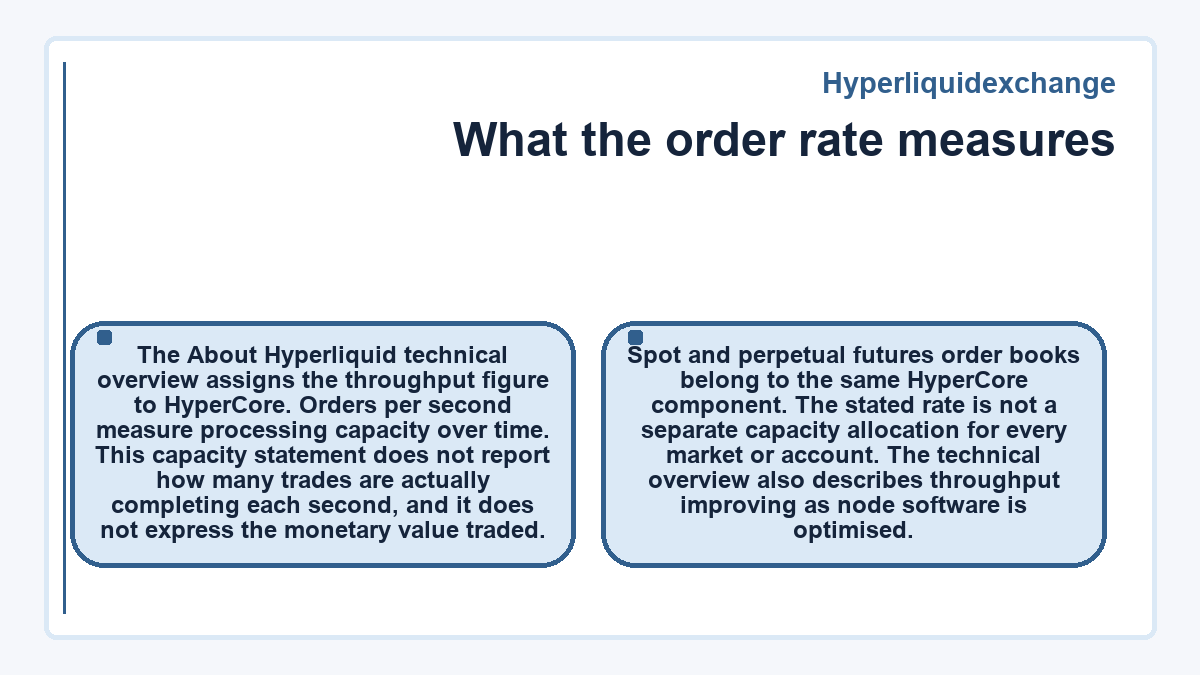
Spot and perpetual futures order books belong to the same HyperCore component. The stated rate is not a separate capacity allocation for every market or account. The technical overview also describes throughput improving as node software is optimised.
HyperCore and HyperEVM workloads compared
| Component | Documented workload | How the order-rate figure applies |
|---|---|---|
| HyperCore | Fully onchain spot and perpetual futures order books. | The stated capacity of 200 000 orders per second applies to this component. |
| HyperEVM | General-purpose EVM smart contracts, with HyperCore’s liquidity and financial primitives available as building blocks. | HyperCore’s order rate does not establish a transaction rate for general-purpose smart contract execution. |
| HyperBFT secures the execution state of both components, providing a shared consensus foundation for their different workloads. | ||
Hyperliquidexchange: HyperCore throughput explained
- What the order rate measures
- HyperCore and HyperEVM workloads compared
- Finality and block time
HyperEVM makes HyperCore’s financial primitives available to applications on the same blockchain.
Finality and block time
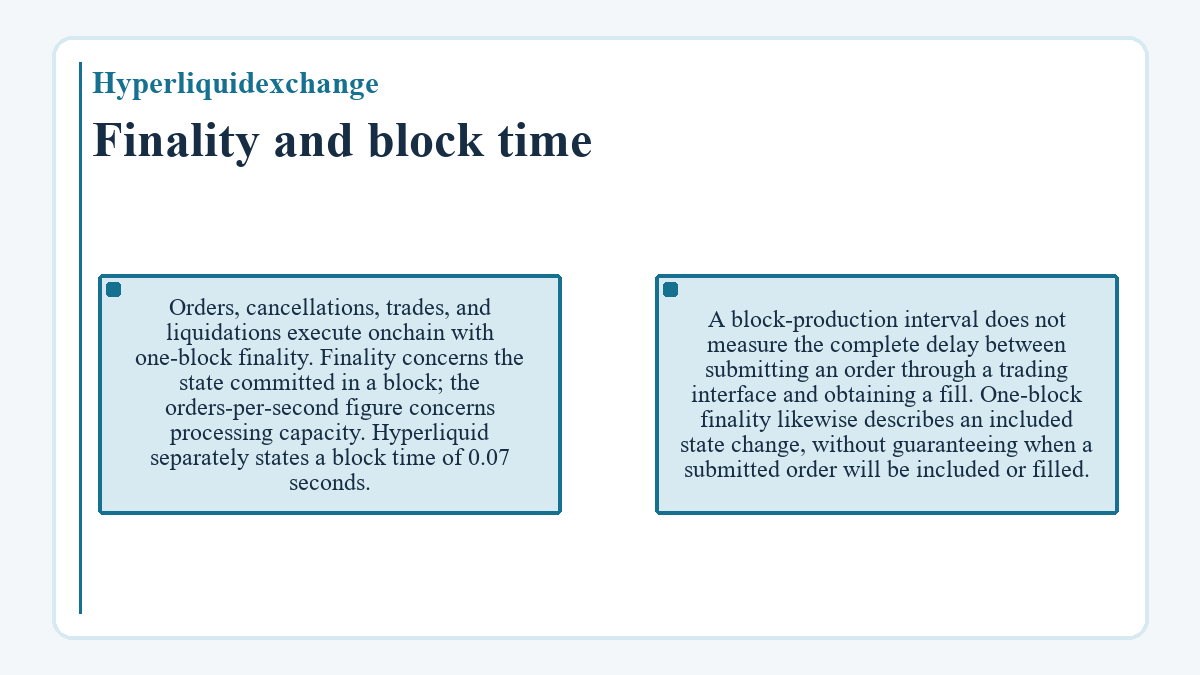
Orders, cancellations, trades, and liquidations execute onchain with one-block finality. Finality concerns the state committed in a block; the orders-per-second figure concerns processing capacity.
Hyperliquid separately states a block time of 0.07 seconds. A block-production interval does not measure the complete delay between submitting an order through a trading interface and obtaining a fill. One-block finality likewise describes an included state change, without guaranteeing when a submitted order will be included or filled.